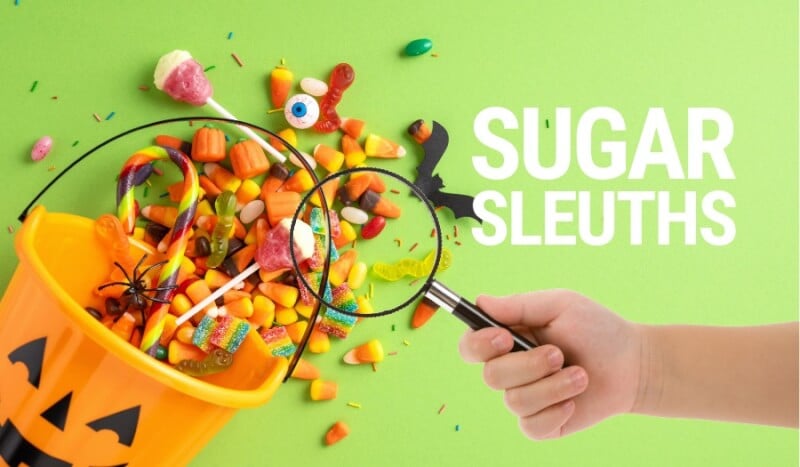
Instead of a post-Halloween candy standoff, turn that sweet stash into a fun, hands-on learning game. As Sugar Sleuths, kids can be detectives as they explore what’s inside their treats, compare “quick” versus “long-lasting” energy, and build smart habits—without turning nutrition into a lecture.
The Sugar Detective Game
What You’ll Need
- 5–10 different wrapped candies (mini chocolate bars, gummies, lollipops)
- Access to nutrition info (check the multipack label or brand site)
- White Sugar
- Measuring spoons to portion sugar (4 g ≈ 1 tsp)
- A small bowl, beaker or drinking glass to measure sugar into.
- Paper and pencil
1) Pick and predict.
Place out 5–10 candies.
Ask: “Which has the most sugar? Which has the least?” Let kids guess first.
2) Read the label. (or check online)
Find grams of sugar per serving and note the serving size (mini vs regular).
Write the number down for each candy.
3) Make it visible.
Measure out the sugar using teaspoons (4 g = 1 tsp) into a clear glass or small bowl. Seeing the actual sugar beside each candy makes the numbers real.
4) Rank and discuss.
Which candy surprised you? Do gummies always beat chocolate? Does your favourite treat have more or less sugar than your least favourite? Does the size or weight of the treat affect the amount of sugar it contains?
Take it a Step Further with Energy Comparisons: Quick vs Long-Lasting
- 1 fun-size chocolate bar = roughly the energy of 1 apple — but the apple’s fibre helps the energy last longer.
- 5 mini candies = roughly the energy of a small peanut butter sandwich — but the sandwich provides the protein/fats that will keep you full longer.
- 1 lollipop = roughly the energy of a small yogourt cup — but the yogourt provides protein for a steadier energy.
- Pair a treat with fruit, yogurt, or nuts to slow the “sugar spike.”
- Plan a treat window (after school or after dinner) so candy doesn’t crowd out meals.
- Use portions—pre-pack a few pieces into small containers so kids learn balance.
Helpful Tips:
Note: Some links may be affiliate links. If you choose to shop through them, we may earn a small commission at no extra cost to you. We only recommend items we believe offer real value to families.
Age Guide: Adapting Sugar Sleuths to suit your child
- 5–7 years: Keep it visual. Parents read labels; kids sort “more vs less.”
- 8–10 years: Kids record numbers, convert grams to teaspoons, rank candies.
- 11–12 years: Add the energy comparison and pairing strategy; let them lead.
- 13–15 years: Reframe as a quick nutrition lab. Consider a digital chart or spreadsheet.
Keep It Body-Neutral
Avoid diet language. Focus on energy and how different foods help us play, learn, and feel good. Try phrases like: “Candy gives quick energy; pairing it with fruit or yogurt helps your body use that energy better.”
Sugar Sleuth Chart
Create a one-page chart kids can fill out while they play:
- Columns: Candy | Serving Size | Sugar (g) | Teaspoons | Quick or Long?
- Back page: “Energy Swaps” notes and favourite candy + pairing ideas.
- Or Download our Free Sugar Sleuth Chart (printable).
Helpful Tools
- Colourful Kids’ measuring spoons and beakers set: Amazon.ca
- Compact digital scale: Amazon.ca
- Reusable portion containers for pre-packing treats: Shop Melii Baby
Once kids understand “quick vs long-lasting,” it’s easy to fold this into a simple post-Halloween system—like a weekly treat plan or a “candy bank” where kids earn and spend treats with clear limits.
Try this next: Halloween Candy Hacks: Fun Ways for Parents to Manage the Sweet Stash